duggi

exad

Tampilkan postingan dengan label Ford Motor Company. Tampilkan semua postingan

Sabtu, 14 Februari 2015

Ford invests $2.3 Billion in Spanish plant to increase production by 40%

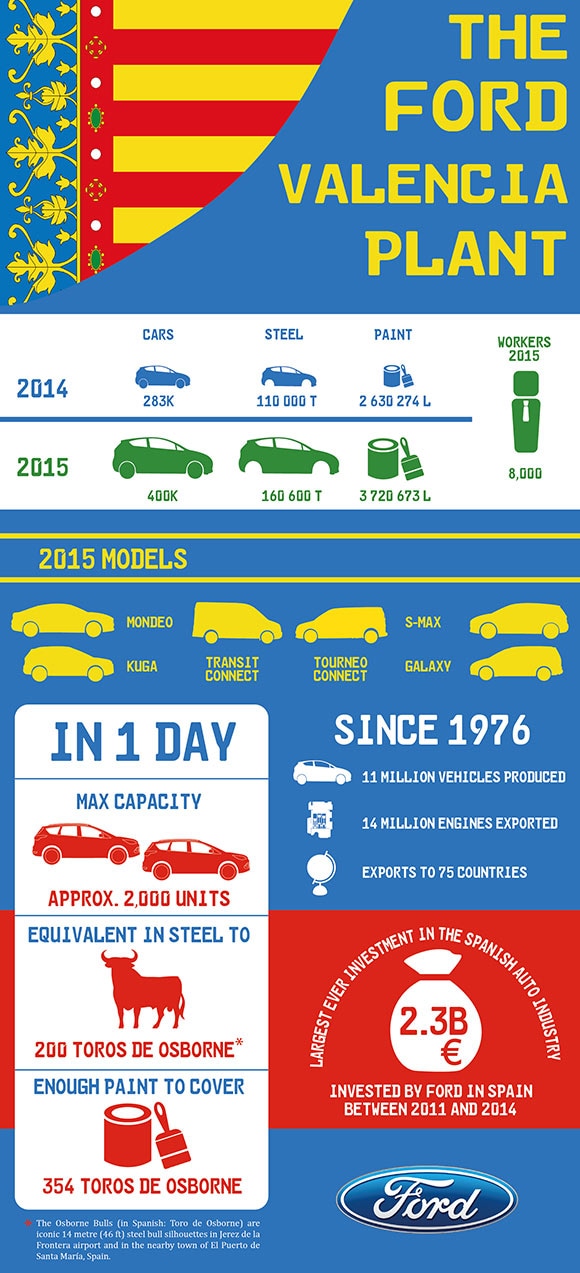
  • Ford Motor Company invests €2.3 billion since 2011 in Valencia, Spain, manufacturing operation; largest ever investment in Spain’s auto industry
  • Vehicle production in Valencia will increase 40 per cent to around 400,000 units in 2015; new high-tech bodyshop raises daily production capacity to 2,000 vehicles
  • With six nameplates in 2015, even more bodystyles, and the capacity to manufacture up to 450,000 vehicles a year, Valencia is one of Ford’s largest and most flexible plants worldwide
  • Ford Valencia operations now employ 8,000 people, up from just below 5,000 in early 2013;  supplier operations supporting Valencia production have increased employment by 1,500 jobs since 2013
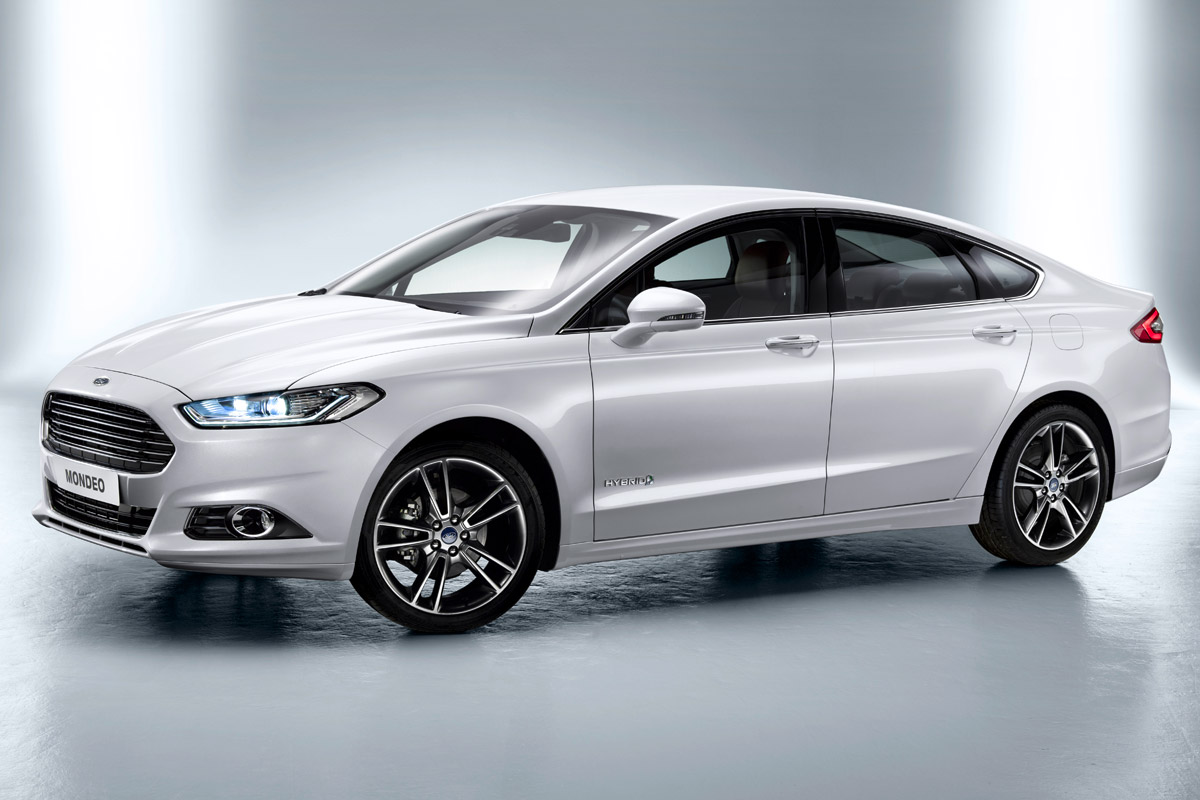
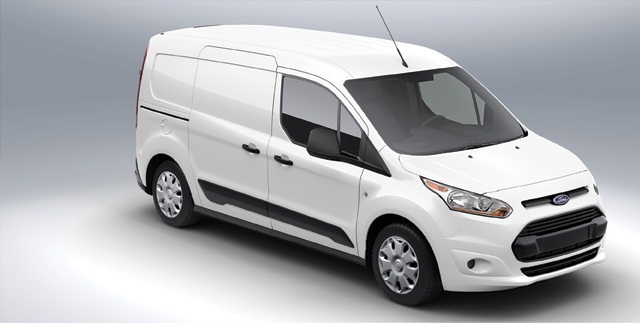
  • Valencia plant currently builds Mondeo wagon, five-door, and four-door including Mondeo Hybrid, Kuga SUV, Transit Connect light commercial vehicle and Tourneo Connect people-mover; all-new S-MAX multi-activity vehicle, Galaxy seven-seat people-mover and Vignale Mondeo go into production later this year
  • Valencia is one of Spain’s top automotive exporters, with 80 per cent of its production to 75 countries worldwide, including North America
Ford Motor Company today announced it is completing the final part of a €2.3 billion investment in its Valencia, Spain, manufacturing operations, transforming it into one of the world’s most advanced, flexible and productive auto plants.

The investment by Ford is the largest in the history of Spanish auto industry and will allow the Valencia plant to increase vehicle production by 40 per cent this year to about 400,000 vehicles, and will have the capacity to potentially build up to 450,000 vehicles a year.


Valencia also is today one of Spain’s top automotive exporters, with 80 per cent of its production being exported worldwide.


Ford now employs about 8,000 people at the facility, up from just below 5,000 in early 2013. Supplier operations supporting Valencia production also have added 1,500 jobs since 2013.
“This world-class facility will help Ford’s accelerate its growth in Europe and around the world,” said Mark Fields, Ford president and chief executive officer. 

“Valencia is not only a major hub of production – building vehicles and engines exported to 75 countries worldwide – but also a centre of innovation employing some of the industry’s most advanced lean, flexible and environmentally friendly manufacturing processes.”

In 2015, Valencia will build six Ford nameplates and even more body styles. The plant currently builds the all-new Mondeo wagon, five-door, and four-door including the Mondeo Hybrid, Kuga SUV, Transit Connect light commercial vehicle and Tourneo Connect people-mover. The all-new S-MAX multi-activity vehicle, Galaxy seven-seat people-mover and the Vignale Mondeo go into production later this year.

The investment consisted of an initial €1.1 billion announced in 2011, followed by a further €1.2 billion since 2013. Valencia will be the sole European production source for all six Ford nameplates assembled at the plant.  

Flexible, modern and efficient


The Ford Valencia facility has produced more than 11 million vehicles and 15 million engines since production started in 1976. The plant was officially opened by King Juan Carlos and Henry Ford II helping Spain emerge from decades of isolation from the global economic stage.

Almost 40 years later, the plant is at the forefront of Ford’s plan to accelerate the pace of the progress on its One Ford plan, deliver product excellence and incorporate innovation into every part of the business.

A new 89,000 m2 bodyshop constructed over nearly eight months raises the plant’s vehicle production capability to about 2,000 units per day. For production of Mondeo and Mondeo Hybrid, the plant was retooled to deliver an industry-first application of hydro-formed high strength steel.

Ford has constructed an additional paint shop, installing automated paint processes that remove the need for paint-drying between application stages, and dirt detection technology. This improves quality while delivering energy and productivity savings.

New assembly line processes make Valencia among Ford’s most efficient facilities, essential to managing the increased complexity of producing more models and derivatives than any Ford facility in Europe. For example, in line with the global Ford Production System, all production components are now transported alongside the vehicle in a pre-assembled kit, saving time and effort.

Since 2011 more than 900 new robots have been installed in the Valencia bodyshops, and 34 in the final assembly areas to help deliver the highest quality standards. Nearly 600 highly skilled engineers are involved in supporting the high-tech production processes in Valencia.
“Mondeo, S-MAX and Galaxy will grow the number of parts we manage from 7,000 to 18,000, requiring some fresh and innovative solutions,” said Tony Ades, operations manager, Valencia. 

“Strong relationships with unions and local government have been essential to developing a flexible facility that can respond quickly and efficiently to changes in demand for our vehicles, with a highly trained and motivated workforce able to operate across our assembly lines.”

Last year, the plant contributed to Ford’s sustainability goals by recycling 3,850 tonnes of wood, paper and cardboard, and by improving its efficiency in water and electricity consumption per car by three per cent. 

Vignale Center


Valencia will in 2015 also complete a new Vignale Center, a specially-created department dedicated to ensuring exacting levels of quality and fulfilling customer expectations of Ford’s new upscale Vignale product and ownership experience.


Vignale debuts this year with the Ford Vignale Mondeo, and each vehicle will pass through an additional sign-off process where trained experts will assess criteria including paint finish and panel alignment assisted by the latest laser and camera technology.

“Ford is the engine behind automotive industry growth in Spain,” said Jose Machado, chairman, Ford of Spain. “The combination of innovative product, forward-looking investment, strong local relationships, and hardworking, flexible employees will continue to deliver meaningful progress in improving our overall business in Europe.”

Minggu, 08 Februari 2015

USA - Ford increases workforce on new F-150 trucks to meet ever increasing demand.

  • Ford is adding 1,550 new jobs to its Kansas City Assembly, Dearborn Stamping, Dearborn Diversified and Sterling Axle facilities to meet growing demand for the all-new 2015 F-150 – the toughest, smartest, most capable F-150 ever
  • As part of Ford’s commitment in the 2011 UAW-Ford collective bargaining agreement, approximately 300 to 500 workers – the first group of “new traditional” employees – will transition in the first quarter, based on attrition and growth, to $28.50 an hour 
  • The entry-level agreement has enabled Ford to invest more than $6.2 billion in its U.S. plants and hire more than 15,000 hourly UAW members – up from the 12,000 jobs that were promised by 2015 in the contract agreement
  • In January, Ford F-Series had its strongest sales month since 2004; F-150 sits just 12 days on dealer lots – turning faster than any other Ford vehicle
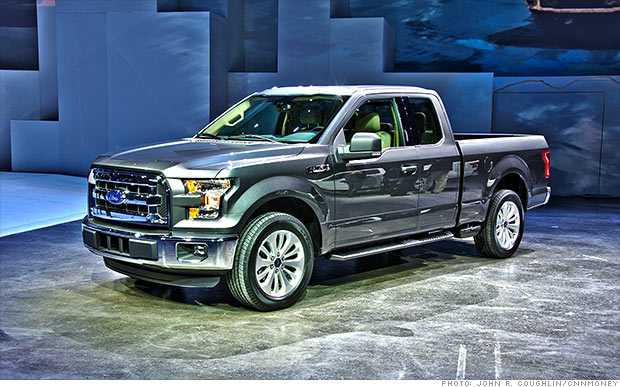
As Ford ramps up production of the all-new F-150, the company today announced it will add 1,550 new jobs across its Kansas City Assembly, Dearborn Stamping, Dearborn Diversified and Sterling Axle facilities in the first quarter of 2015. The new jobs will support production and growing customer demand for the recently launched 2015 Ford F-150.


With these new jobs, Ford has reached its entry-level allowance outlined in the 2011 UAW-Ford collective bargaining agreement. As a result, approximately 300 to 500 workers – the first group of “new traditional” employees – will transition, based on attrition and growth, from their entry-level wage of $19.28 an hour to their new wage of $28.50 an hour. The majority of these employees work at Kansas City, Chicago and Louisville assembly facilities.

“Thanks to stronger than expected customer demand, we’re adding 1,550 new workers to support additional F-150 production,” said Joe Hinrichs, Ford president, The Americas. “These jobs are further proof that customers recognize the all-new F-150 as the toughest, smartest, most capable F-150 ever. We sell every truck we can build, and we plan to build more.”

Of the 1,550 new jobs, 900 are allocated for Kansas City Assembly and 500 will be added between Dearborn Stamping and Dearborn Diversified, with the remaining 150 jobs going to Sterling Axle. These jobs are in addition to the more than 5,000 hourly jobs Ford added across its U.S. manufacturing facilities in 2014. 

“This is very exciting news and these additional jobs will have an impact in communities all across our nation,” said Jimmy Settles, UAW vice president and director, National Ford Department. “This also represents a major milestone for employees hired under the entry level agreement, as many will now begin to convert to ‘new traditional’ wage status, as negotiated in the 2011 collective bargaining agreement.”

The entry-level agreement negotiated as part of UAW-Ford collective bargaining has helped improve Ford’s competitiveness and enabled the company to invest more than $6.2 billion in its U.S. manufacturing facilities. Ford has hired more than 15,000 hourly UAW members – exceeding its goal of creating 12,000 hourly jobs in the United States by 2015.

Toughest, smartest, most capable F-150 ever


The all-new F-150 is the toughest, smartest and most capable F-150 ever – boasting a military-grade, aluminum-alloy body and high-strength steel frame, and shedding up to 700 pounds for a lighter, more efficient truck than any previous F-150.


These weight savings lead to customer benefits regardless of model configuration or engine choice. The innovative new truck can tow up to 1,100 more pounds and haul up to 530 more pounds than the 2014 model, and has the highest EPA-estimated fuel economy ratings of any full-size gasoline pickup on the market. When equipped with an available 2.7-liter EcoBoost® engine, the new F-150 4x2 has EPA-estimated fuel economy ratings of 19 mpg city, 26 mpg highway and 22 mpg combined. Actual mileage may vary.

Numerous groundbreaking features debuted in the all-new F-150, including these class-exclusives:
  • 360-degree camera view uses exterior cameras to create a bird’s-eye view of the truck to help drivers park, maneuver in tight spots, and navigate narrow roads and trails
  • Integrated loading ramps enable easy loading of ATVs, motorcycles and mowers
  • BoxLink cargo management system combines metal brackets and custom cleats to secure a variety of accessories in the cargo box – from ramps to storage bins to bed dividers
  • Trailer hitch assist adds a new rearview camera feature that incorporates a dynamic line based on steering wheel angle in the display to help customers line up their truck and trailer with no spotter or need to exit the vehicle
  • Remote tailgate allows for tailgate to be locked, unlocked and released with the key fob
To manufacture the all-new Ford F-150, the truck team designed an innovative process that includes the latest in advanced materials and in forming and joining technologies.  

The new manufacturing process called for the overhaul of both Dearborn Truck and Kansas City Assembly facilities. Dearborn Truck saw its largest manufacturing transformation in decades wherein legacy manufacturing equipment was replaced with the latest in production technology. Changeover at the facility was completed last fall. Kansas City Assembly is currently undergoing a similar renovation that is scheduled to be complete in early 2015. 

Combined, the two plants will have capacity to produce more than 700,000 trucks per year for availability in 90 markets globally.

F-150 is part of Ford F-Series, celebrating its 38th straight year as America’s best-selling truck and 33rd straight year as America’s best-selling vehicle. Ford sold 753,851 trucks in 2014.

The all-new F-150 is off to a tremendous start. In January, Ford F-Series had its strongest sales month since 2004, which was the company’s best sales year for the F-150 ever. In the first month of 2015, F-150 sat just 12 days on dealer lots – turning faster than any other Ford vehicle. In addition, more than 1 million people have built and priced F-150 configurations on Ford’s website.

Kamis, 29 Januari 2015

USA - RECALLS - FORD - Two recalls from Ford for over 210,000 vehicles, its started already.

Ford is issuing two safety recalls. No accidents or injuries are attributed to either of these conditions. Details are as follows:

Ford issues safety recall for certain 2010-2013 Ford Taurus, Lincoln MKS and Ford Police Interceptor sedans for interior door handle issue

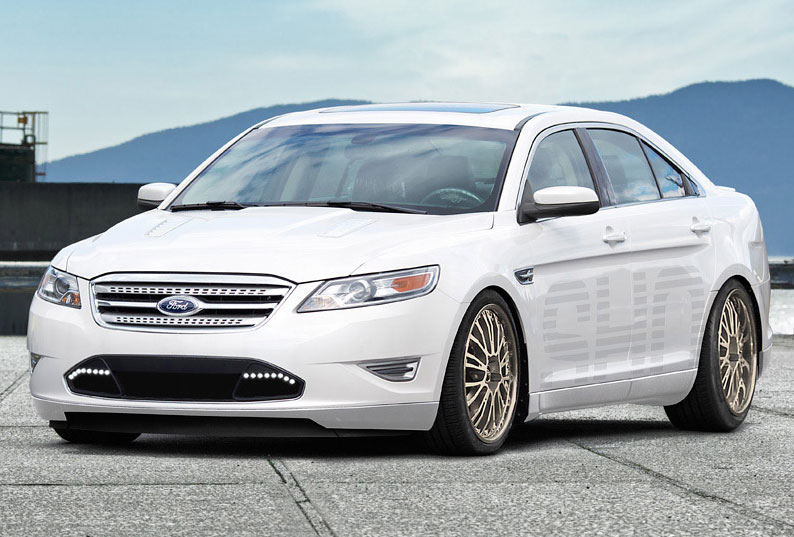
Ford is issuing a safety recall for approximately 205,000 2010-2013 Ford Taurus, Lincoln MKS and Ford Police Interceptor sedans due to an issue with the spring that controls the interior door handles. If the spring is unseated, the door may become unlatched in a side-impact crash, increasing the risk of injury.


Ford is not aware of any accidents or injuries related to this condition.

Affected vehicles include certain 2010-2013 Ford Taurus vehicles built Dec. 1, 2009 to July 31, 2010 and Feb. 1, 2011 to Nov. 30, 2012 at Chicago Assembly Plant; certain 2010-2013 Lincoln MKS vehicles built June 2, 2011 to Oct. 31, 2011 at Chicago Assembly Plant; and certain 2010-2013 Ford Police Interceptor sedans built Dec. 1, 2009 to July 31, 2010 and Feb. 1, 2011 to Nov. 30, 2012 at Chicago Assembly Plant.

Ford is aware of 204,945 vehicles in North America, including 194,889 in the United States and federalized territories, 9,948 in Canada and 108 in Mexico.

Dealers will inspect all four interior door handle assemblies and repair or replace the handles as necessary. This will be done at no cost to customers.

Ford issues safety recall for certain 2014 Ford Transit Connect vehicles for safety belt fastener torque issue

Ford is issuing a safety recall for approximately 16,100 2014 Ford Transit Connect vehicles for a potential issue with safety belt fasteners that may not have been tightened properly. Safety belt fasteners that do not meet installation torque specifications may loosen over time, which may cause them not to function as intended, increasing the risk of injury in a crash.


Ford is not aware of any accidents or injuries related to this condition.

Affected vehicles include certain 2014 Ford Transit Connect vans built Nov. 6, 2013 to Sept. 20, 2014 at Valencia Assembly Plant. All 16,091 vehicles are located in the United States.

Dealers will replace and properly tighten the safety belt fasteners. This will be done at no cost to customers. Dealers will also replace and properly torque the cargo tie-downs in the cargo area.

Jumat, 23 Januari 2015

Ford to tweak EcoSport to make it a better buyers choice - about time too, it is awful.

Ford Motor will offer the EcoSport SUV in Europe without the spare wheel on the outside of the rear tailgate after the SUV's sales got off to a slow start.
The EcoSport has failed to make a big impact in the region’s booming subcompact SUV/crossover segment against sleeker-looking rivals such as the Renault Captur, Peugeot 2008 and Opel/Vauxhall Mokka.

When the India-built EcoSport launched in Europe last year, Ford said the vehicle’s rear design could not be changed.
Ford now says the EcoSport will be sold in Europe without the exterior spare wheel starting in May. It will be an option offered at no extra cost, a Ford spokesman said. The EcoSport’s rear door will remain side-hinged.
The SUV’s redesign will also include new interior plastics and changes to the suspension. “We want to give it a bit more Fiesta personality,” the spokesman said. The Fiesta subcompact hatchback is Ford’s No. 1 seller in Europe.
IHS Automotive analyst Ian Fletcher said Ford appears to have made a “big misstep” with the EcoSport in Europe, given the potential growth in the segment in the next couple of years.
Ford sold 11,257 EcoSports in Europe through November after launching the model in April, according to figures from JATO Dynamics.
The segment leader, the Renault Captur, had sales of 149,701 during the same period. The Peugeot 2008, the No. 2 seller, had sales of 125,002 while Opel sold 114,658 Mokkas.

IHS forecasts that European sales of subcompact SUVs will grow to more than 900,000 by 2017 from 500,000 last year, boosted by new arrivals such as the Fiat 500X, which IHS predicts will sell over 70,000 units to put it fifth behind the Captur, 2008, Nissan Juke and Mokka.
IHS forecasts that Ford will sell 20,239 EcoSports in Europe this year, instead of its original prediction of 36,000 sales.
Ford designed the EcoSport to suit customers’ tastes in its main markets of India and Brazil where buyers prefer rugged-looking vehicles. Late last year Ford started production of the EcoSport in Russia to take advantage of the country’s growing SUV market.
Nick Gibbs

Jumat, 19 Desember 2014

Ford shuts Genk, Belgium facility with the loss of nearly 12,000 jobs.

Ford Motor produced the last car at its plant in Genk, Belgium, today, closing the site which produced some 14 million vehicles over the past 50 years.
The company decided in late 2012 to shut the factory, which employed about 4,000 people, and relocate production of the Mondeo, S-Max and Galaxy models to Valencia, Spain.

"It seems so unreal. I think I'll only notice after the holidays. It's winter time, you're at home and have no idea what to do. That's when it will hit," said 60-year-old Rudi Beys on his way to one of his final shifts, adding he felt too young to retire.According to a study carried out by the nearby University of Hasselt, the closure of the plant will cost some 11,800 jobs in the greater region, as suppliers to Ford also have to make cuts.
The final car to roll off the production line on Thursday was set to be a white Galaxy van, which will be emblazoned with the signatures of factory staff and will be donated to a charity.

The final shift ended at 2 p.m. local time. The company will keep a few hundred of its staff over the coming months to dismantle assembly lines.
Following the Genk closure and that of an Opel factory in Antwerp in 2010, Belgium now has just two vehicle assembly plants: Audi in Brussels and Volvo Cars in Ghent.

REPORT HERE